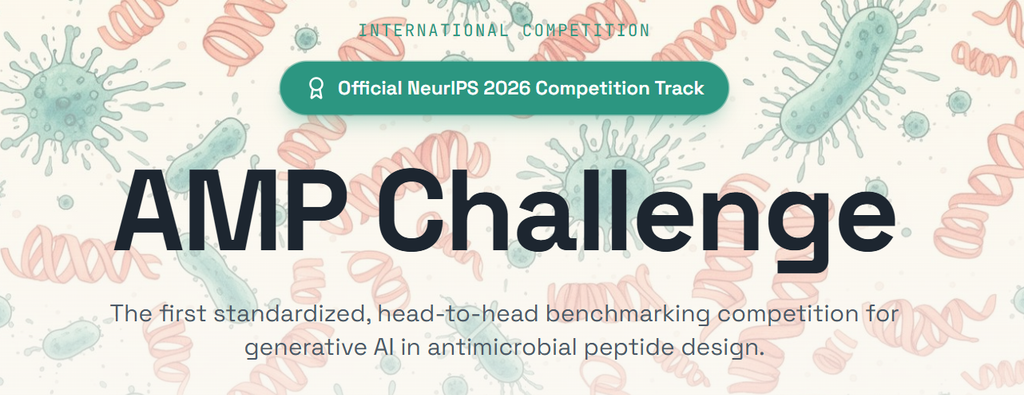
Generative AI for Antimicrobial Peptide Design: Join the NeurIPS 2026 AMP Challenge
Prof. Ewa Szczurek, a member of ELLIS Unit Warsaw, is among the organisers of the AMP Challenge, an international competition focused on the use of generative artificial intelligence in antimicrobial peptide design. The initiative has been accepted to the official NeurIPS 2026 Competition Track.
Antimicrobial resistance is one of the most pressing challenges facing modern healthcare. Antimicrobial peptides, or AMPs, represent a promising class of potential therapeutics, while generative AI offers new possibilities for designing peptide candidates. However, comparing different computational approaches remains difficult, as existing studies frequently rely on different datasets, experimental protocols and candidate-selection procedures.
The AMP Challenge aims to address this problem by establishing the first standardised, head-to-head benchmark for generative AI methods in antimicrobial peptide design. Participating teams are invited to generate libraries of peptide sequences and identify their most promising candidates using a generative approach of their choice.
A maximum of 20 teams will advance to the experimental validation stage. If the number of qualifying submissions exceeds the available capacity, teams will be ranked on the basis of computational evaluation. For each advancing team, 25 peptides will be selected from its ranked candidate list, synthesised and tested at no cost to the participants.
The experimental validation will be carried out by the group of Prof. César de la Fuente at the University of Pennsylvania. Peptides will be tested against 20 clinically relevant bacterial strains, including multidrug-resistant pathogens, using the same protocols and experimental conditions for all teams.
The challenge is designed to improve the reproducibility and comparability of generative approaches to antimicrobial peptide design. Its planned outcomes include an open benchmark dataset, model repositories and a joint benchmarking publication. Experimental results, including data on both successful and unsuccessful peptide candidates, are expected to be made publicly available under a CC BY 4.0 licence.
The organising committee brings together researchers from Helmholtz Munich, the University of Warsaw and the University of Pennsylvania. It includes Prof. Ewa Szczurek, who leads research groups at Helmholtz Munich and the University of Warsaw and is a member of ELLIS Unit Warsaw. Her research focuses on artificial intelligence and its applications in computational medicine, including AI-driven antimicrobial peptide design.
The deadline for submissions is 1 October 2026 (AOE). The AMP Challenge has been accepted to the official NeurIPS 2026 Competition Track. The Competition Track workshops, where the accepted competitions will be presented and discussed, are scheduled for 11-12 December 2026.
More information about the competition, submission requirements and evaluation framework is available on the AMP Challenge website.